
Why Your Jaw Won’t Relax: The TCM Connection Between Stress, Tension and TMJ
By Karina Dunn | Traditional Chinese Medicine Practitioner
Have you ever noticed yourself clenching your jaw while working, driving, concentrating or even while you sleep?
For many people, jaw tension becomes so familiar that they barely notice it until it begins to show up in other ways — through headaches, facial tension, neck and shoulder tightness, clicking or discomfort around the jaw.
From a Traditional Chinese Medicine perspective, the jaw is not viewed as an isolated part of the body. The muscles, meridians and nervous system are all interconnected, and tension in the jaw can often reflect what is happening more broadly within the body.
Stress, emotional tension, poor sleep and prolonged periods of muscular holding can all contribute to the way we carry tension through the face and jaw.
At Nuha Collective, we often use acupuncture and specialised buccal massage to work with these patterns from both a local and whole-body perspective.
Why Do We Hold So Much Tension in the Jaw?
The jaw is one of the areas of the body that can respond almost immediately to stress.
You may notice yourself clenching while concentrating at your computer, tightening your jaw while driving, or waking in the morning with a feeling that your teeth have been pressed together throughout the night.
Over time, this unconscious holding can become a pattern.
Jaw tension may be accompanied by:
Jaw clenching or teeth grinding
Clicking or restriction when opening the mouth
Facial tension or discomfort
Tension headaches
Neck and shoulder tightness
Difficulty fully relaxing the muscles around the face
A feeling of heaviness or fatigue through the jaw
For some people, these symptoms are closely connected with periods of increased stress or poor sleep. For others, the tension may have developed gradually over many years and become something they simply consider normal.
The body, however, is always communicating. Sometimes the jaw is simply one of the places where accumulated tension becomes most noticeable.
The TCM Perspective
In Traditional Chinese Medicine, the jaw sits at the meeting point of several important meridian pathways, including the Stomach, Gallbladder, Small Intestine and Triple Burner channels.
The Liver is also particularly relevant when we look at patterns of muscular tension.
In Chinese medicine, the Liver is responsible for the smooth movement of Qi throughout the body. When this movement becomes constrained, we may experience a sense of tension or stagnation, both physically and emotionally.
This can present alongside symptoms such as headaches, muscle tightness, irritability, frustration, digestive changes, PMS and jaw clenching.
The experience of feeling stressed or unable to fully relax can also contribute to increased muscular holding. When the body remains in a heightened state for long periods, it can become more difficult for muscles to soften and return to a relaxed resting state.
This is why, rather than simply treating the place where pain is felt, acupuncture considers the broader pattern within the body.
The Connection Between Stress and the Jaw
Many of us are familiar with the idea of holding stress in the shoulders, but the jaw is another common place for the body to store tension.
We may clench without realising it when we are under pressure, hold our breath while concentrating, or grind our teeth during sleep.
Over time, this can create a cycle where the muscles become accustomed to being partially contracted, making it harder for them to fully relax.
This is also why simply being told to “stop clenching” is often not enough.
The pattern may have become an automatic response within the body, rather than something we are consciously choosing to do.
Supporting the nervous system, improving sleep, releasing muscular tension and addressing the underlying patterns contributing to stress can all be part of a more complete approach.
How Buccal Massage Can Help
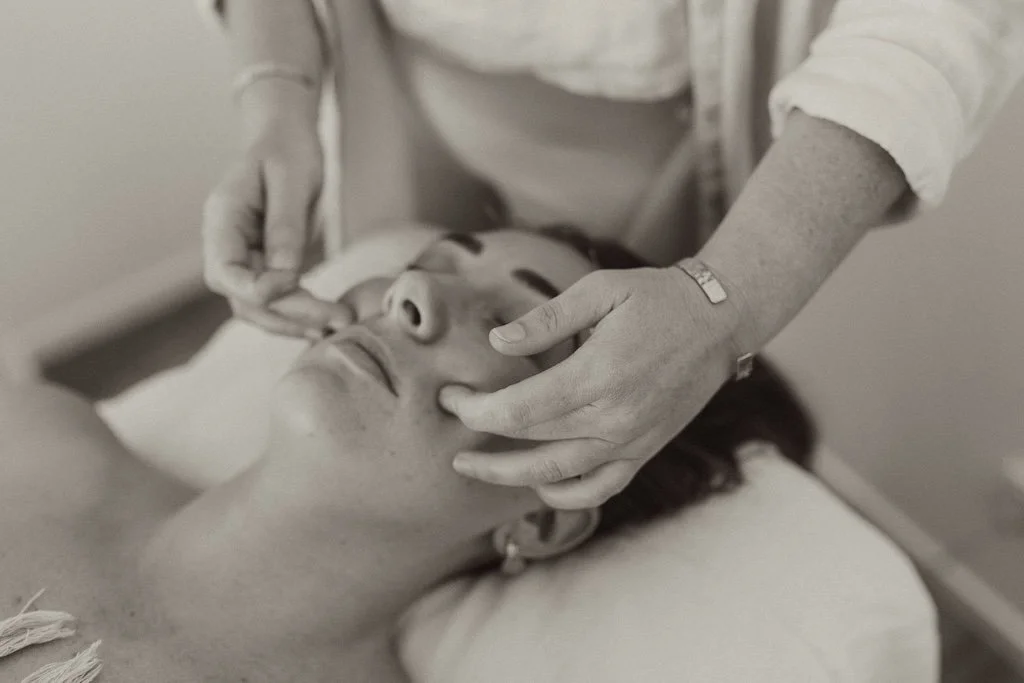
Buccal massage is a specialised facial massage technique that works both externally and from inside the mouth.
The intraoral component allows the practitioner to work with deeper muscles of the cheeks and jaw that can be difficult to access through external massage alone. These include muscles involved in chewing and jaw movement, such as the masseter, buccinator and pterygoid muscles.
By working directly with these deeper tissues, buccal massage can help to release areas of muscular tension and restriction while encouraging circulation through the face.
It may be particularly supportive for people experiencing jaw tightness, clenching, teeth grinding, facial tension or tension headaches.
Many people also enjoy the treatment simply because of how deeply relaxing it can feel. When the muscles of the face and jaw begin to soften, there can be a noticeable sense of physical release.
Why Combine Buccal Massage and Acupuncture?
Buccal massage and acupuncture work in different but complementary ways.
Buccal massage works directly with the muscles and soft tissues of the face and jaw, helping to release physical restriction and tension.
Acupuncture takes a broader approach. Through the lens of Traditional Chinese Medicine, treatment is tailored to the individual and may address patterns involving stress, circulation, muscular tension, digestion, sleep and the smooth movement of Qi.
Together, the two treatments allow us to work with both the physical tension being held in the jaw and the wider patterns that may be contributing to it.
This can be particularly helpful when jaw tension is accompanied by headaches, neck and shoulder tension, stress or difficulty switching off.
When Jaw Tension Becomes a Pattern
Sometimes we don't realise how much tension we have been carrying until we experience what it feels like to let it go.
The jaw is involved in so much of everyday life — speaking, eating, expressing emotion and responding to stress — and it can quietly become a place where we hold more than we realise.
Creating space for the muscles to soften can therefore be about more than simply relieving discomfort. It can also become an opportunity to notice how the rest of the body responds when it is given permission to relax.
Supporting the Body Beyond the Treatment Room
While treatment can be helpful, supporting jaw health also involves noticing the patterns that may be contributing to tension in everyday life.
You may find it helpful to become more aware of whether you are clenching during the day, particularly while working or concentrating. Taking regular breaks, allowing the tongue and jaw to soften, breathing more slowly and paying attention to posture can all help bring awareness back to the area.
Sleep is another important part of the picture, particularly for those who grind or clench at night.
If you are experiencing persistent jaw pain, locking, significant clicking or difficulty opening your mouth, it is also important to seek appropriate dental or medical assessment alongside complementary treatment.
A Holistic Approach to Jaw Tension
At Nuha Collective, we believe that the body is best understood as a whole.
Jaw tension may be experienced in the face, but it can be influenced by the neck, shoulders, breath, nervous system, sleep, stress and the wider patterns of the body.
Through Traditional Chinese Medicine, acupuncture and specialised buccal massage, we can support the body in releasing physical tension while also working with the patterns that may be contributing to it.
If your jaw has been feeling tight, tired or overworked, it may be worth paying attention to what it is asking for.
Sometimes the first step towards relief is simply creating a little more space for the body to soften.
Buccal Massage & Acupuncture at Nuha Collective
At Nuha Collective, our Buccal Massage and Acupuncture treatment combines specialised intraoral facial massage with Traditional Chinese Medicine acupuncture to support jaw tension, facial tension and stress-related muscular holding.